

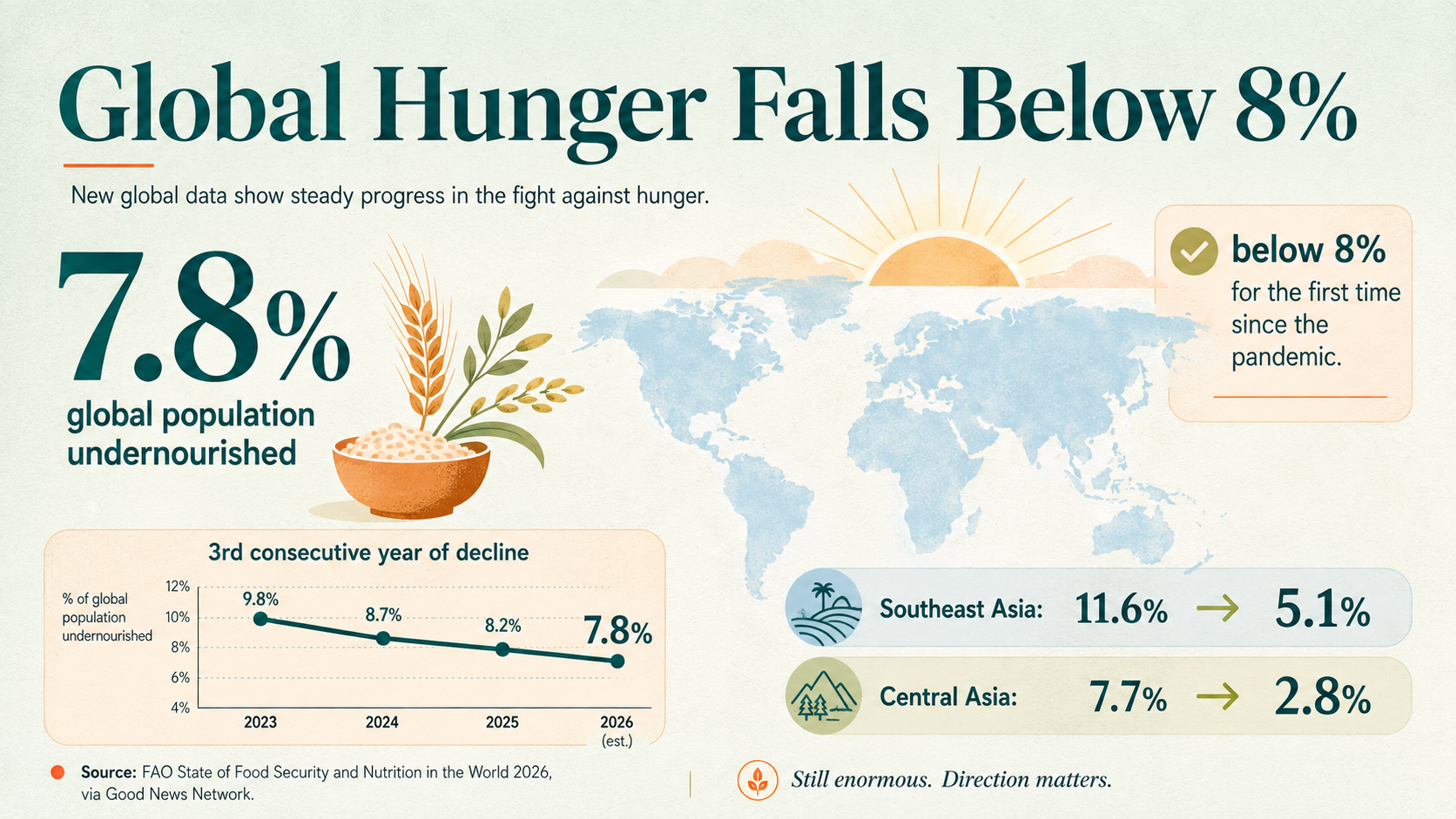
A hopeful report about hunger has to begin with the truth: too many people still do not have enough food, income, safety, or stability.
That is not a small problem. It is not a solved problem. It is not something a beautiful chart can tidy up.
But the full picture also includes another truth: over the last generation, the world has made real progress against extreme poverty. The data does not say the work is finished. It says the work has mattered.
What the global poverty data says
The World Bank estimates that around 831 million people are living in extreme poverty, defined by the international poverty line of less than $3 per day in 2021 purchasing power parity terms.
That number is painfully large.
It also used to be much larger.
According to the World Bank, the number of people living in extreme poverty fell from about 2.3 billion in 1990 to 831 million in 2025. Much of that decline was driven by broad-based economic growth in East Asia and South Asia.
Our World in Data describes the decline in global extreme poverty over the last generation as one of the most important changes in the modern world.
The cleanest way to say it is this:
- In 1990, about 2.3 billion people lived in extreme poverty.
- In 2025, about 831 million people did.
- That is still 831 million too many.
- It is also a decline of roughly 1.5 billion people.
Both facts belong in the same sentence.
Where progress has slowed
The World Bank is clear that poverty reduction has slowed in the last decade.
The reasons are not simple. Slower economic growth, high debt, the effects of the pandemic, conflict, fragile institutions, and severe weather shocks have all made progress harder. Extreme poverty is also increasingly concentrated in Sub-Saharan Africa and in places affected by conflict and fragility.
At the current pace, the World Bank says it could take decades to end extreme poverty.
That is the part of the report that should keep us awake.
Progress is real, but it is not automatic. It depends on choices, institutions, investment, peace, opportunity, health, education, infrastructure, and the daily work of people building a more stable future.
What hunger has to do with it
Extreme poverty and hunger are not identical, but they are deeply connected.
When income is that low, food becomes one of the first and hardest pressures. Families may skip meals, buy cheaper and less nutritious food, pull children from school, delay medical care, sell assets, or take on debt to survive.
Our World in Data notes that the poorest people in the world are often undernourished and lack access to basic services such as electricity, safe drinking water, education, and health care.
So when we talk about poverty reduction, we are not talking only about income. We are talking about whether a family has enough margin to eat, stay healthy, learn, work, and plan for more than the next emergency.
Why Sept. 11 is a meaningful day to act
The organization 9/11 Day says companies and volunteers across the country will gather on September 11, 2026, for what it describes as the largest single-day meal pack in history: 50,000 volunteers in more than 50 U.S. cities packing 18 million meals for families in need.
That kind of effort does not solve hunger by itself. No single day does.
But it gives people a concrete place to begin. It turns concern into meals. It gives memory a practical shape. It reminds us that large problems are met through many specific acts, repeated by many people.
For readers who want to participate, 9/11 Day has an individual volunteer signup page for meal-packing opportunities.
Volunteer with 9/11 Day: https://www.911day.org/volunteer/meal-packs/
Other ways to help feed people beyond 9/11
Not everyone can attend a Sept. 11 meal pack. That is fine. Hunger work is needed before and after one national day of service.
A few practical options:
- Find a local food bank and sign up for a volunteer shift through Feeding America: https://www.feedingamerica.org/take-action/volunteer
- Donate to a local food bank or hunger-relief organization.
- Host a food drive or virtual food drive with a workplace, neighborhood, school, church, or community group.
- Support school meal programs, senior meal delivery, community fridges, mutual-aid pantries, and local organizations already trusted in your area.
- During September, join Hunger Action Month efforts that raise awareness and support for neighbors facing hunger: https://www.feedingamerica.org/take-action/hunger-action-month
The best first step is often local. Food banks know what they need most, and the answer is not always canned goods. Sometimes it is money, volunteers, delivery help, translated materials, warehouse support, advocacy, or consistent monthly giving.
The takeaway
The data gives us a serious kind of hope.
It does not say hunger is small. It does not say poverty is almost over. It does not ask us to look away from the people still living with urgent need.
It says something more useful: human effort has reduced extreme poverty before, and human effort is still needed now.
We can notice the progress, face the remaining need, and choose one concrete way to help feed people.
The problem of hunger isn’t easy to solve.
But evidence shows that action matters.
Let’s take action.